
Lifestyle Block Security
Gate to Shed
Alarms, gate and driveway cameras and shed security for lifestyle blocks, designed around the distances between your buildings — from installers based in Whenuapai.
The risk is out past the house
Securing a lifestyle block is a different job from securing a house in town. The house is usually the easy part. The risk is everything around it: the road gate, a long drive nobody can see from the kitchen, and the sheds with the quad bike, the tools and the fuel in them.
Two things change the design. The buildings are far apart, so getting power and signal out to them is the real question. And nobody hears a siren on a block, so an alarm has to tell someone, on a phone or in a control room, or it is just noise in an empty paddock.
We are based in Whenuapai, a short drive from Kumeu, Huapai and Riverhead, and we do the alarms, the cameras and the network links ourselves.
From the road gate to the back shed
The road gate
The first point anyone crosses. A camera aimed where vehicles slow for the gate, and a detector that tells you someone is coming before they reach the house.
The driveway
Outdoor detectors along the drive, so a vehicle at 2am becomes an alert on your phone rather than something you find out about in the morning.
Sheds & workshops
Opening and motion detection, a siren on the wall, and photos with the alarm from a MotionCam, so you can see what set it off.
Garages & sleepouts
Covered from the same system as the house, usually with no cable dug across the lawn.
The house
A normal alarm, set up so it is easy to arm when you go out, with pet-immune detectors where the dogs live inside.
Yards & machinery
Cameras over where vehicles, floats and machinery park, aimed to identify, not just to record that something moved.
Three ways to reach a building
Picked per building, by distance and line of sight.
Cable where it makes sense
A network cable powers a camera and carries its picture for about 100 metres. For most garages, sheds near the house and a gate close to it, that is the simplest and most reliable answer.
A wireless link to the shed
Where trenching is not practical, a pair of directional point-to-point radios joins the shed to the house network. House-to-shed distances of 50 to 300 metres are routine with a clear line of sight.
Battery detectors by radio
Ajax detectors run on their own batteries for years and talk to the hub by radio, up to about 1.7 to 2 km in open ground. A range extender covers what a shelter belt or a hill takes away.
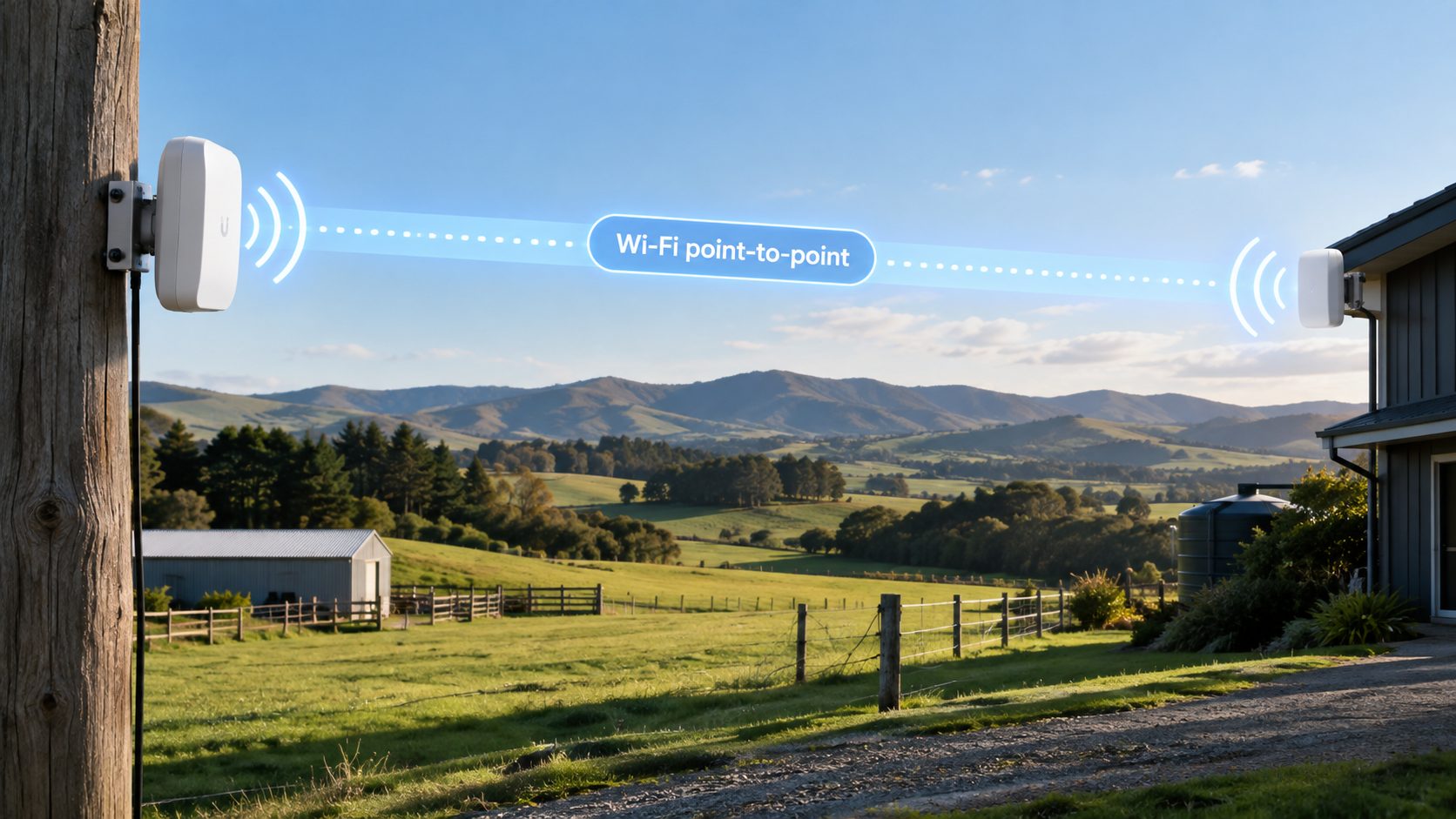
Cameras, alarm and WiFi on one plan
A link to the shed does not just carry cameras. The same connection can put WiFi in the workshop or sleepout, so the phone works out there too. We do networks as well as security, so we design them together instead of leaving you with two systems that do not talk.
Power cuts are more common out of town, and an alarm or camera system that goes dark with the mains is no use. Alarm hubs carry their own backup battery and report over 4G when the internet drops. The recorder and network gear can go on a backup supply too.
Nobody hears a siren on a block
On a block, the alarm going off is only half the job. The other half is who finds out. There are two ways to set it up, and many owners use both.
Phone alerts, with photos from MotionCam detectors, tell you straight away and let you see whether it is a person, a possum or a gate the wind has caught. Monitoring by Alarm Watch's 24/7 control room means someone acts on the alarm even if you are asleep, overseas or out of signal, calling you, your keyholders or emergency services, as you have instructed them.
What it depends on
Wireless links need line of sight
Trees, a ridge or another building in the way can stop a point-to-point link. We check the path on the site visit. If it is blocked, the answer is a taller mount, a relay point or cable.
Animals set off outdoor detectors
Stock, dogs, cats and possums are why outdoor detection needs careful placement and settings. We position detectors around where animals actually move, not just where people might.
4G is not everywhere
Most of the north-west is well covered, but a gully or the far side of a hill may not be. We test signal where the hub will go before we quote.
How we set up a block
Walk the Block
We walk the property with you: the gate, the drive, every building, and where power and network already reach.
Plan the Reach
Cable, wireless link or battery radio for each building, chosen by distance and line of sight, with the signal tested.
Fixed Quote
A clear price before anything starts, with each camera, detector and link listed so you can see what it is for.
Install & Test
Every detector walk-tested, every camera checked on your phone, alerts set up with you before we leave.
Where we work: Kumeu, Huapai, Riverhead, Taupaki, Waimauku, Muriwai, Helensville, Coatesville, Dairy Flat and the rest of the rural north-west, plus Whenuapai and Hobsonville on the way.
Worth reading next
West Auckland
Alarm and CCTV installation across the west.
Read moreWiFi & point-to-point
Networks for the house, the shed and the gate.
Read moreTP-Link VIGI cameras
The PoE cameras we fit most, including for long drives.
Read moreAjax MotionCam
Detectors that send a photo with every alarm.
Read moreAlarm monitoring
What a 24/7 control room does when the alarm goes off.
Read moreHobsonville & Whenuapai
Our home patch, a few minutes from the blocks.
Read moreCommon questions
Yes. Depending on distance and line of sight, we run cable, add a point-to-point wireless link, or use battery-powered Ajax detectors that reach the hub by radio. We test which works on the site visit.
It can if it is chosen and placed for that: a narrower view, aimed where vehicles slow for the gate, with enough light at night. A wide camera on the house will see a car, not read its plate.
A PoE camera takes its power down the network cable, so a cable or a powered wireless link is enough. For detection only, battery Ajax detectors need no power at all.
Usually more than in town, because no neighbour will hear the siren. Alarm Watch's 24/7 control room acts on the alarm and follows your instructions, even when you are away.
Not if it is set up around them. Inside, pet-immune detectors suit dogs and cats. Outside, we place detectors and set sensitivity around where stock and pets actually move.
Alarm hubs have a backup battery and can report over 4G, so the alarm keeps working. The recorder and network gear can go on a backup supply as well.
Yes, for the alarm brands we install: Ajax, Paradox and Arrowhead Elite. We can also add cameras or a link to the shed alongside an existing system.
The rural north-west from our Whenuapai base: Kumeu, Huapai, Riverhead, Taupaki, Waimauku, Muriwai, Helensville, Coatesville and Dairy Flat, plus the rest of Auckland.
Sources
Ajax's published specifications, checked October 2026.
Secure the Whole Block
A walk around the property, a plan for every building and a fixed price before anything starts — from Whenuapai, minutes from the north-west blocks.
Get a Free Quote